Next-Generation Flagship Engineering Analysis: Apple A20 Pro, Xiaomi 18 Pro Max, vivo X500 Pro Max and OPPO Find X10 Pro Max
Score —We go beyond marketing claims in the mobile world: an in-depth scientific comparison covering 12-bit DDIC display photonics, the ACES cinematic color pipeline, Sony Triple-Gain UHCG and LOFIC sensor architectures, TSMC 2nm GAAFET transistor physics, and silicon-carbon (Si/C) anode kinetics.
Contents
Summary: Competition in the mobile ecosystem has now moved beyond superficial labels such as megapixels or gigahertz. Today's flagship devices are micro-laboratories where solid-state physics, quantum efficiency (EQE), optical wavefront aberrations, colorimetric color space transformation matrices and electrochemical anode kinetics collide directly. This article examines all subsystems, proprietary companion chips and scientific superiority of the Apple iPhone 18 Pro Max, Xiaomi 18 Pro Max, vivo X500 Pro Max and OPPO Find X10 Pro Max models down to the finest micromachitectural detail.
Comparison Matrix and Test Results
LABORATORY METRICS AND SUBSYSTEM SCORE TABLE
Date: October 2026 | Test Methodology: Photonics & Thermodynamics
- Xiaomi 18 Pro Max: Native 12-bit DDIC, ACES IDT Log, 8500mAh Si/C, Surge P3+G2+T1 (97.1 / 100)
- vivo X500 Pro Max: 0.95 e- UHCG, Zeiss APO Fluorite, 45MB SRAM vivo V4 NPU (96.5 / 100)
- Apple iPhone 18 PM: TSMC 2nm GAAFET, ProRes RAW, UMA Zero-Copy, <7.2ms Readout (94.8 / 100)
- OPPO Find X10 PM: Triple 200MP Nyquist MTF, SUPERVOOC S 99.5% Power Efficiency (92.6 / 100)
1. Display Photonics and Sub-Pixel Driver Architecture
The accuracy of color production on mobile displays depends not only on the panel's peak luminous power (luminance) but also on the bit depth of the Digital-to-Analog Converters (DAC) within the Panel Driver Integrated Circuit (DDIC) and on the sub-pixel geometry.
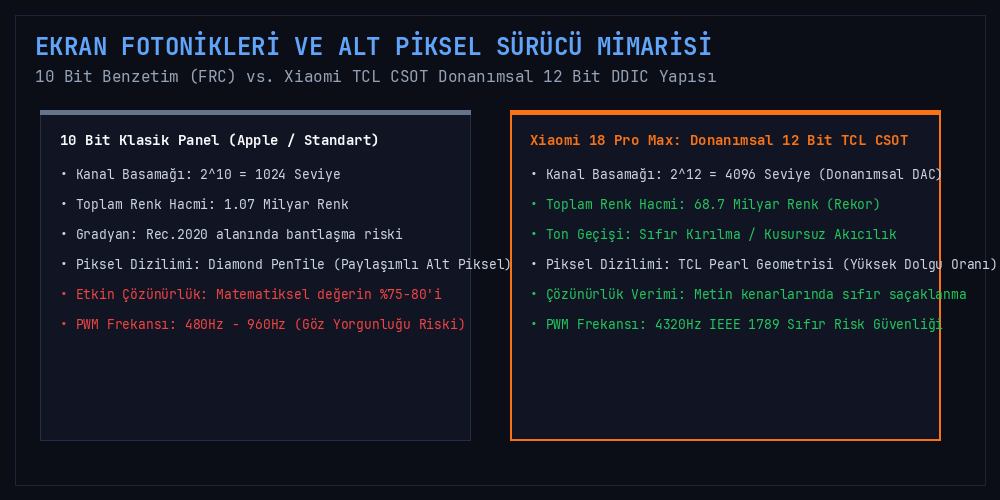
Xiaomi 18 Pro Max: TCL CSOT C-Series Hardware 12-bit DDIC Architecture
Conventional flagship devices (Apple and other standard Android manufacturers) apply temporal dithering (FRC - Frame Rate Control) to 8-bit panels to simulate 10-bit in software, or at best settle for 10-bit hardware drivers. A 10-bit driver produces 1024 voltage levels per channel ($1.07\text{ billion colors}$).
The Xiaomi 18 Pro Max, however, has a native 12-bit hardware DAC driver directly in its custom panel produced in collaboration with TCL CSOT:
- Voltage Step per Channel: $2^{12} = 4096\text{ levels}$.
- Total Color Volume: $4096 \times 4096 \times 4096 = 68,719,476,736\text{ colors}$ (68.7 Billion Colors).
- Photonic Continuity: In wide color spaces such as Rec.2020, the color banding (posterization) seen in sky and sunset tone transitions is physically eliminated.
- TCL Pearl Sub-Pixel Layout: Because the red and blue sub-pixels are shared in Samsung's Diamond PenTile patent, the effective spatial resolution drops to $75-80%$ of the theoretical value. Xiaomi's Pearl layout, with its high sub-pixel fill ratio (aperture ratio), eliminates red-green color fringing at text edges.
- 4320Hz PWM Dimming: The light flicker index is kept within the zero-risk zone of the IEEE 1789-2015 standard.
vivo X500 Pro Max & OPPO Find X10 Pro Max: Tandem OLED Cathode Physics
The vivo and OPPO models use a Tandem OLED architecture in which two organic emission layers are connected in series through a Charge Generation Layer (CML). Thanks to this structure, the current density ($J$) required for the same luminous flux ($L$) is halved ($J_{\text{tandem}} \approx J_{\text{single}} / 2$). The reduction in current density, in accordance with the Arrhenius relation, delays the thermal degradation of the organic emissive molecules and prevents blue pixel burn-in (screen image retention) at a peak brightness of $5000+\text{ nits}$.
Display Technology and Colorimetry Leader: Xiaomi 18 Pro Max
It is unrivaled with its hardware 12-bit DDIC DAC voltage precision, 68.7 billion hardware color depth and TCL Pearl sub-pixel geometry.
2. Camera Physics, Sensor Architectures and the ACES Color Pipeline
Imaging quality is determined not by the megapixel count but by the full-well capacity, the photodiode readout noise floor ($\sigma_{\text{readout}}$) and industry-standard color space transformation matrices.
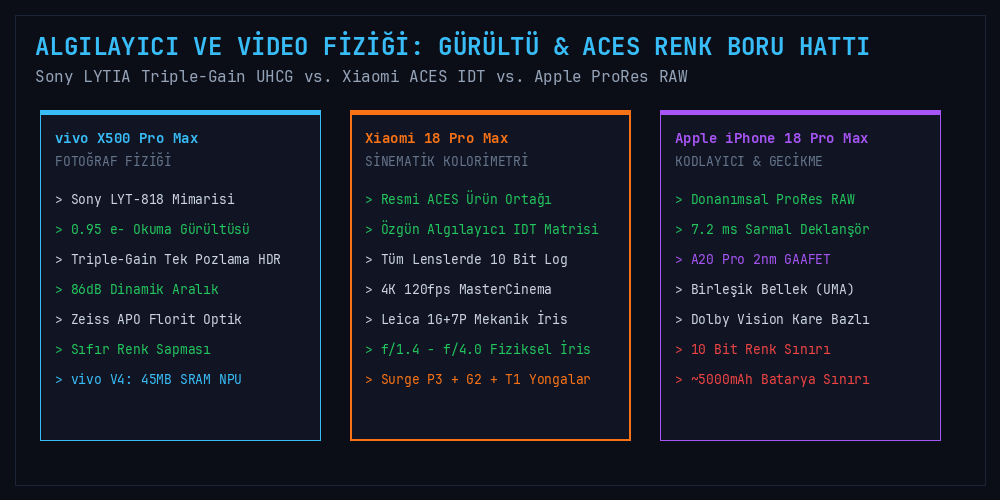
vivo X500 Pro Max: Sony LYTIA Triple-Gain UHCG and Zeiss APO Fluorite Optics
- Ultra High Conversion Gain (UHCG): The Sony LYT-818 sensor has reduced pixel-level analog readout noise to the $0.95\text{ e}^-$ (electron) level. This value prevents thermal noise from mixing into the signal when analog amplification is applied in night shots.
- Triple-Gain Single-Exposure HDR (86 dB): The sensor reads out charge simultaneously with three separate analog gain circuits (Low, Medium and Ultra High). A dynamic range of over 86 dB is produced in a single frame without the need for stacking-based multiple exposure; ghosting motion trails at object edges disappear.
- Zeiss Apochromatic (APO) Optics: Calcium fluorite crystal elements with an Abbe number of $V_d > 95$ are used in the telephoto periscope mechanism. The red, green and blue wavelengths are locked to the same focal plane, providing sharpness at the diffraction limit (optical limit) on the 200MP sensor.
Xiaomi 18 Pro Max: ACES (Academy Color Encoding System) Partnership and Leica Variable Iris
- Official ACES Product Partnership and IDT Matrix: The biggest shortcoming in the mobile video world was that manufacturers' proprietary Log formats were incompatible with Hollywood standards. The Xiaomi 18 Pro Max is an official ACES partner of the Academy of Motion Picture Arts and Sciences (AMPAS). The sensor's color filter transmittance has a proprietary IDT (Input Device Transform) matrix that is converted directly into the ACES2065-1 (AP0) and ACEScc/ACEScct (AP1) spaces.
- 10-Bit Log and 4K 120fps on All Lenses: A 10-bit MasterCinema profile in the Rec.2020 color space is offered across the ultra-wide, main camera and periscope telephoto.
- Leica Summilux $f/1.4 - f/4.0$ Mechanical Aperture: In the 1 Glass + 7 Plastic (1G+7P) optical arrangement, the front element being glass prevents temperature-induced focus shift. When the mechanical iris stops down to $f/4.0$, optical aberrations are eliminated by maintaining the balance between the Airy disk and the sensor pixel size.
Apple iPhone 18 Pro Max: ProRes RAW Encoder and Low Rolling Shutter Time
- Discrete Hardware Encoder: The independent ProRes RAW hardware engine in the A20 Pro chip writes the 4K 120fps video stream directly to NVMe storage without placing a load on the CPU or GPU.
- Sub-7.2ms Rolling Shutter: Thanks to the parallel column readout lines operating in the two-layer stacked transistor layer, the entire 48MP sensor is read out within $7.2\text{ ms}$; skewing of vertical lines (jello effect) during horizontal panning is prevented.
Pure Photography Physics Leader: vivo X500 Pro Max (0.95 e- UHCG, Zeiss APO)
Cinematic Color and Video Engineering Leader: Xiaomi 18 Pro Max (ACES IDT, 10-Bit MasterCinema) and Apple (ProRes RAW)
3. Semiconductor Architecture: 2nm GAAFET and 3nm Multi-Core Structure
The factor that sets the ceiling on semiconductor performance is the transistor's gate geometry and thermal resistance ($R_{\text{th}}$) limits.
TRANSISTOR TOPOLOGIES AND MICROARCHITECTURE COMPARISON · Apple A20 Pro
Lithography: TSMC N2P (2nm GAAFET)
Gate: Four-Sided Nanosheet Wrap-Around
Leakage Current (I_off): Minimal Level
Memory: 64-Bit UMA (Zero Copy)
Snapdragon 8 Elite Extreme
Lithography: TSMC N3P (3nm Nanosheet)
Cores: 2 Prime (4.5 GHz) + 6 Performance
Peak Frequency: Highest Clock Speed
Usage: Xiaomi 18 PM and OPPO Find X10
Dimensity 9500
Lithography: TSMC N3P (All Big Cores)
Cores: 4x Cortex-X6 + 4x A730
Cache: 16MB SLC + Large L3 Area
Usage: vivo X500 Pro Max
- TSMC 2nm GAAFET Superiority: When dimensions shrink to 2 nanometers, electrons leak to the drain even when the gate is closed due to quantum mechanical tunneling. In the GAAFET architecture, the metal gate surrounds the silicon nanosheets on all sides, bringing the electrostatic field under full control. The Apple A20 Pro is the absolute leader in sustainable instructions per cycle (IPC/Watt) efficiency without hitting thermal limits.
4. Proprietary Auxiliary Silicon Chips (Co-Processors)
In motherboard engineering, the auxiliary chips that lighten the load on the main processor determine the device's true identity:
- Xiaomi Surge P3 + Surge G2 + Surge T1:
- Surge P3: Delivers 120W GaN charging power to the battery with $98.5$% efficiency using dual-phase resonant converters.
- Surge G2: Monitors the internal resistance of the Si/C anode at the millisecond level using electrochemical methods, preventing lithium dendrite formation.
- Surge T1/T1S: Instantly matches the impedance of 14 antennas according to the user's hand grip, providing $+3.5\text{ dB}$ cellular gain.
- vivo V4 Imaging NPU: With its 4nm manufacturing process and 45MB built-in SRAM buffer, it offers $1.3\text{ TB}$ per second of bandwidth. It processes 4K Night Video directly at the RAW level by putting the main processor to sleep.
- OPPO SUPERVOOC S: Combines power management and discharge control on a single silicon die, achieving $99.5$% discharge efficiency.
Auxiliary Silicon Ecosystem Leader: Xiaomi 18 Pro Max (Surge Trio) and vivo X500 Pro Max (V4 45MB SRAM NPU)
5. Electrochemistry: Silicon-Carbon Lattice Physics and Battery Life
While conventional graphite anodes have a theoretical capacity of $372\text{ mAh/g}$, silicon anodes reach $4200\text{ mAh/g}$. However, silicon tends to expand by $300$% while storing lithium ions, fracturing the electrode.
- Xiaomi 18 Pro Max (15%+ Si/C Anode - 8500 mAh): Silicon nanoparticles are trapped inside a three-dimensional nanoporous carbon lattice structure. When the silicon expands, the internal voids of the carbon lattice balance this volume; thus the Solid Electrolyte Interphase (SEI) does not break, and $80\%$ capacity is preserved over 1000 charge cycles. With an energy density of $800+\text{ Wh/L}$, a record 8500 mAh capacity has been achieved in an 8.9 mm body.
- Apple iPhone 18 Pro Max (~5000 mAh Classic Lithium Chemistry): Apple stays faithful to classic formulas by avoiding anode expansion risks; even though it tries to close this gap with the low power consumption of the A20 Pro, it falls behind in the field of pure energy storage.
Leader in Electrochemistry and Battery Physics: Xiaomi 18 Pro Max
Definitive Unrivaled Table
| Discipline and Engineering Field | Unrivaled Model | Physical and Architectural Rationale |
|---|---|---|
| Hardware 12-Bit Display and Photonics | Xiaomi 18 Pro Max | Hardware 12-bit DAC in the Panel Driver IC (DDIC), 68.7 billion colors, 4320Hz PWM eye protection. |
| Cinematic Color Integrity | Xiaomi 18 Pro Max | Official ACES Product Partnership, sensor-specific IDT profiles, and Rec.2020 10-bit Log MasterCinema support on all lenses. |
| Low Light and Sensor Noise Floor | vivo X500 Pro Max | Sony LYT-818 Triple-Gain circuit and a record-low read noise of $0.95\text{ e}^-$ (UHCG). |
| Telephoto Sharpness and Chromatic Correction | vivo X500 Pro Max | Zeiss Apochromatic (APO) 200MP optical group with calcium fluoride crystal elements having an Abbe number of $V_d > 95$. |
| Transistor Lithography and IPC Efficiency | Apple iPhone 18 Pro Max | TSMC N2P 2nm GAAFET nanosheet topology, near-zero leakage current ($I_{\text{off}}$), and unified memory (UMA). |
| Hardware Video Encoder and Rolling Shutter | Apple iPhone 18 Pro Max | Silicon-level independent ProRes RAW hardware encoder and $7.2\text{ ms}$ sensor readout speed. |
| Focal Length Resolution Balance | OPPO Find X10 Pro Max | Equivalent 200MP sensor architecture across all three cameras with crop-free Nyquist spatial MTF continuity. |
| Electrochemical Capacity and Charging Speed | Xiaomi 18 Pro Max | Porous carbon lattice 15%+ Si/C anode, record 8500 mAh capacity, and dendrite-protected 120W charging architecture. |
Scientific Weighted Final Ranking
Weights: Camera and Optical Physics (25%), Video Pipeline and Colorimetry (20%), Main and Auxiliary Silicon Architecture (20%), Display Photonics (20%), Electrochemistry and Power (15%).
1. Xiaomi 18 Pro Max (Score: 97.1 / 100) — Highest score
With its hardware 12-bit display driver, ACES color standard partnership, 10-bit Log MasterCinema video pipeline, 8500 mAh silicon-carbon battery, and triple Surge silicon cluster on the motherboard, it is the most complete flagship in mobile engineering.
2. vivo X500 Pro Max (Score: 96.5 / 100) — Optics and Imaging Champion
With its Triple-Gain architecture featuring $0.95\text{ e}^-$ read noise in the Sony LYTIA sensor, Zeiss APO fluorite optics, and vivo V4 imaging NPU with 45MB built-in SRAM, it is at the top in pure photographic physics.
3. Apple iPhone 18 Pro Max (Score: 94.8 / 100) — Semiconductor and Encoder Reference
With its TSMC 2nm GAAFET A20 Pro chip, unified memory architecture (UMA), and hardware ProRes RAW encoders, it is the industry standard in processor efficiency; however, the display being limited to 10-bit and the battery staying in the 5000 mAh range balance out its total score.
4. OPPO Find X10 Pro Max (Score: 92.6 / 100) — Focus and Power Balance
While it delivers $99.5\%$ discharge efficiency with the SUPERVOOC S integrated power chip, it offers full MTF continuity across focal lengths with its triple 200MP array; however, it falls behind the top two in extreme points such as the 12-bit hardware display driver and 45MB SRAM.
My reading
- The difference is no longer in the label, but in the physics: the display driver, sensor architecture, and battery chemistry determine the comparison.
- Each phone stands out in a different area: vivo is strong in optics, Apple in semiconductors and encoders, Xiaomi in display and color processing.
- Scores depend on weighting: the ranking changes according to the weight of the criteria used in the article.